
Even radicals have rules
Keeping the political pressure on with peaceful, playful protest marches
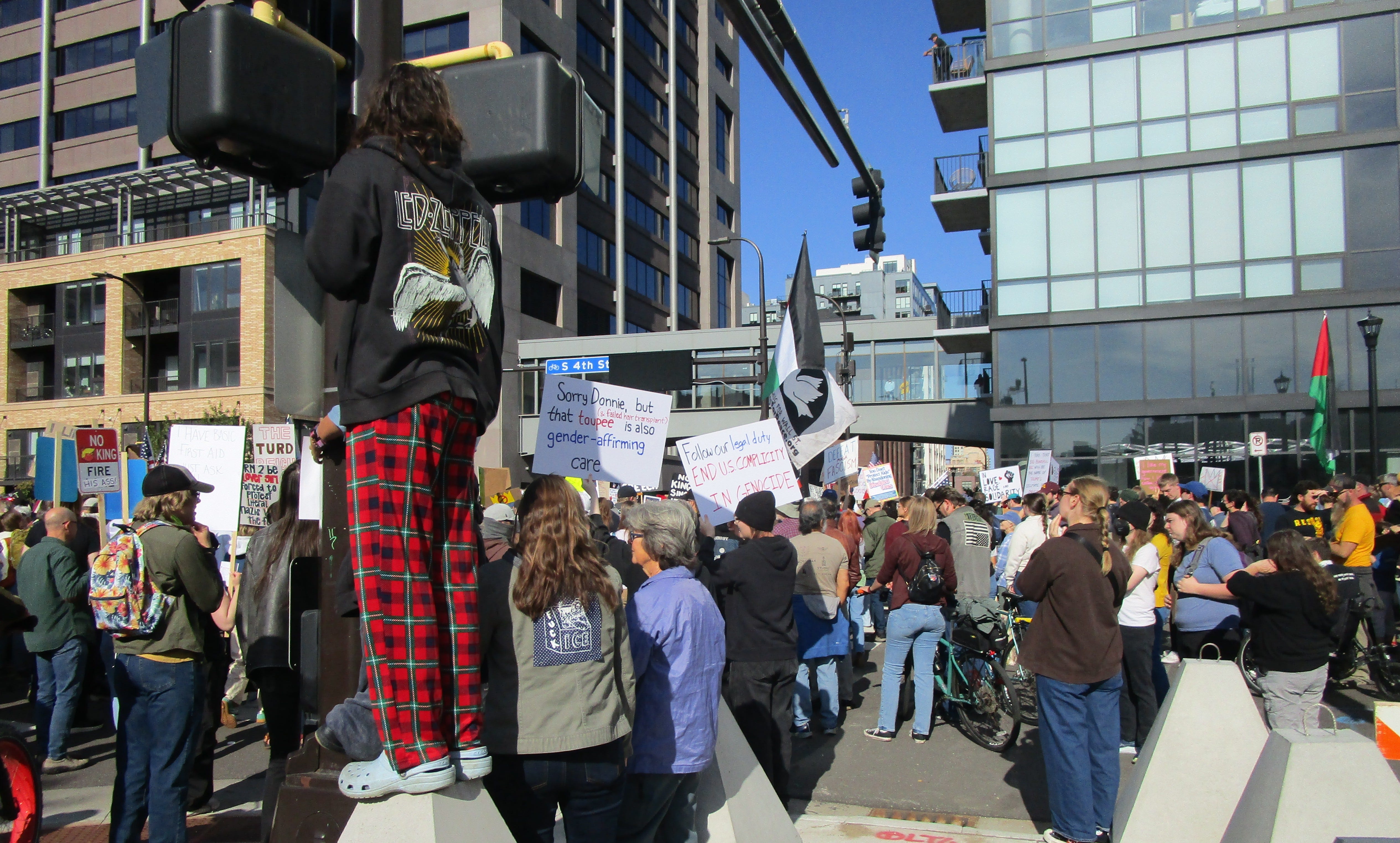
The ‘No Kings’ march in Minneapolis Oct. 18 drew an estimated 100,000 people. Photo: Marilyn Sjotvedt
Until recently, the last time I joined a march with thousands of other people occurred in 1972, protesting the U.S. ‘secret’ bombing of Cambodia. Despite scars that remain, today the small southeast Asia nation bordered by Thailand, Laos and Vietnam appears to be successful and thriving. They trained large rats to sniff out undetonated bombs and land mines littering the landscape.
Bombing of another sort occurred last Saturday after about 7 million people across the U.S. marched to protest the current political regime. The cartoon image of a president in a fighter jet and dropping bombs of poop on fellow Americans is an apt metaphor for the way this administration treats its citizens. While the meme may amuse supporters who fail to see it as infantile behavior, that and similar reactions among the party leadership will further undermine their power.
At the march in Minneapolis Oct. 18, I grossly underestimated my guess of the attendance. Seeing the photos and recalling the almost endless stream of people, I believe 100k is a good guess. I was also encouraged to observe the demographics. In the small city where I have attended previous marches, older folks were in the majority. Now it appears to be all ages.
People power
Reflecting on the experience, it dredged up a related matter, also from 1972. In his book, Rules for Radicals: A Pragmatic Primer for Realistic Radicals, Saul Alinsky laid out strategies and tactics for the common people to generate political power. In 1972 the radicals came from the left. Later on in 2007 it became a template for the Tea Party, which helped lay the groundwork for today’s MAGA. You can find the 13 rules in Wikipedia here.
The book is listed in the bibliography of a paper that I wrote for my MA degree in journalism and mass communication at the University of Minnesota. The context came from the efforts of community activists to have a role in the development of the Cedar-Riverside area on the west bank in Minneapolis. “We all read Alinsky,” said an activist.
So how do these ‘rules’ apply to today? Here are several that might qualify:
“Ridicule is man’s most potent weapon. There is no defense. It is almost impossible to counterattack ridicule. Also, it infuriates the opposition, who then react to your advantage.”
“A good tactic is one your people enjoy.”
“Keep the pressure on.”
Both marches, in 1972 and Saturday, were peaceful, almost party-like. Although the issues were serious, people seemed to be having a good time. The many creative signs and costumes, while meaningful, were entertaining.
Clowning around
My reporter training and habits found me scanning the crowd, trying to estimate numbers, looking for any signs of trouble. My first crowd estimate of about ten thousand is almost embarrassing to mention. In my defense, it was challenging because of the limited view. I was surprised to see it go down Washington Avenue, a major thoroughfare in Minneapolis.
Not seeing any police presence, I looked around for any clues of undercover officers. It would have been very easy to blend in. The only ones in uniform were traffic control officers blocking access to the streets filled with marchers. One group not blending in, we saw and even spoke with a several men dressed up as clowns, and acting like it.
One approached us and asked about one of the signs, which read, ‘Oust the Far Reich’. I tried to explain that the play on words referred to Hitler’s Third Reich, and that the Second and First Reichs were the Austro-German empire prior to World War I, and the Holy Roman Empire, respectively. He looked at me in bewilderment.
Something about the man left me feeling that he wasn’t just another typical marcher. His clownish outfit didn’t conceal his other attributes: Tough-looking, muscular, forties, piercing eyes. Could this be an undercover cop? Maybe a Proud Boy spying on the enemy? He tried to troll me by saying that he had attended a Trump rally. “Oh, that’s nice,” I said.
Getting back to Alinsky’s rules, the rallies clearly accomplish the three mentioned above. The target of the protests seems to have no real sense of humor and is clearly susceptible to substantive ridicule. The marchers seem to be having a good time, even though the subject is very serious. With three major rallies so far, and getting larger, they are keeping the pressure on.
Tea Party too
It is somewhat ironic that Alinsky’s rules informed the strategy of Newt Gingrich’s attack on President Obama in 2012. “Newt Gingrich keeps likening President Obama to radical community organizer Saul Alinsky. But Gingrich seems to have adopted Alinsky’s tactics himself, as has the tea party. Mainstream Republicans aren’t happy,” reads the subhead for a story in the Christian Science Monitor.
It worked for the Republicans to take control of the House in 2010, and the Senate in 2014 while maintaining House control. The future of our nation as a democratic republic depends on a similar outcome in 2026 and 2028. The power of the people as seen in the marches will make the difference.
Research by Erica Chenoweth, a political scientist at Harvard University, conducted with Maria J. Stephan and published in Why Civil Resistance Works (2011), “found that nonviolent movements engaging at least 3.5 percent of a population have never failed to bring about significant political change, such as regime change or major policy shifts.”
In the US today, that amounts to about 11.9 million. The June No Kings rally drew about 5 million. With about 7 million at the Oct. 18 rally, the prognosis is that the numbers will increase at each subsequent rally. Keep in touch at https://indivisible.org/ and make plans to attend the next rally. You will help make a difference, whether or not the U.S.A. will continue as 50 states united in a democratic republic.